Monday, March 15, 2010

Portfolio management – an alternative

Modern portfolio management theory emphasizes risk management through diversification. Simply put, investors are advised to spread their investments across sectors and asset classes, offsetting risk among component weightings. However, this rigid system of diversification avoids market timing aspects of risk and often exposes investors to drawdowns that could be avoided with an approach that better adapts to the market environment.

There are few money managers that employ more aggressive diversification strategies. One upstart investment firm is focused on systematic trading and has caught my eye – Acorn Global Investments Inc. of Oakville, Ontario. A recent paper explains Acorn’s approach:

Systematic Trading: Diversification Done Right

Wednesday, March 03, 2010

Stock picks in the security industry

A fragile balance between global economic recovery, sovereign debt problems, and potentially threatening commodity inflation is the thematic market headline challenging investors early in 2010. However, the stock market is also reminding investors that security issues are a major business opportunity in our time. Threats to our economic security remain the primary driver of capital scurrying between asset classes, but a big challenge for economic well-being in our age is securing commerce - and the population - from threats big and small. Almost a decade after the history-altering terrorist act now referred to as 9/11 stewards of the global economy remain anxious to find systems and technological solutions to security risk. Judging by the performance of many of the stocks that represent this effort to make the world a safer place, the market is doing its job of accepting this challenge.

Although companies in the security industry range across a broad scope of service and systems – from typical security services to high tech applications of screening and warning devices – this loose grouping of enterprises devoted to reducing risks of harmful acts, as well as natural disasters, is worth watching. Recent stock market trends show that investors know the stakes are big, and that economic dislocation and crisis is a tremendous cost for failure to defend against security risk. Some of these security industry stocks are currently delivering trend trading opportunities.

One of the best performing stocks on the Toronto Stock Exchange since the market bottom almost a year ago has been Garda World Security Corp. (GW-T). This Montreal-based security services firm has a worldwide presence, but the 2008 recession pummelled its shares to a penny stock from much loftier heights. The stock took off last year, though, and became Stock Trends Bullish in early June after its initial rally more than tripled the share price from its 2009 open. Since its rebirth as a bullish stock GW has doubled in value again and is now scaling new 52-week highs as its shares approach $12. The share price would have to double again to challenge the highs prior to the stock’s 2007 perch, but trend investors can look toward an advance to the $15 area as an immediate objective.

GW


OSI Systems, Inc. (OSIS-Q), a security scanning systems provider, saw its stock break out in early 2010. Although it has been Stock Trends Bullish for the past three quarters, OSIS upward sloping 13-week moving average is now helping the stock regain a footing above $30 (US). If the share price manages to push ahead of its January high, eclipsing $33, investors will look positively toward adding to their positions.
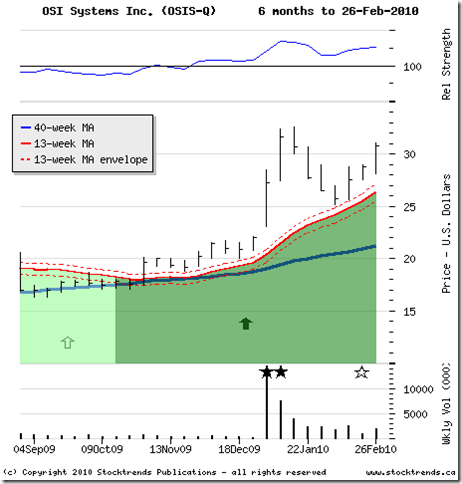
OSIS


ICx Technologies (ICXT-Q) develops sensors and surveillance systems. Its stock, along with the shares of identity security firm IntelliCheck Mobilisa, Inc. (IDN-A), had a huge breakout in the short trading week before the New Year - the holiday attempted airline bombing a blunt reminder of the powerful lever terrorist acts have on these stocks. Share prices in both companies have since slipped back to their 13-week moving average trend line and are trading only lightly now. However, investors can again look at this as another launching pad.

Another bullish trending stock, American Science & Engineering Inc. (ASEI-Q), is currently trading at its 13-week moving average trend line and could also rally to its January high. The shares of this x-ray inspection systems firm would add in excess of 10 per cent on that move.

Analogic Corp. (ALOG-Q) makes explosive detection equipment, but its stock has been somewhat of a dud since its bullish breakout in the first quarter of 2009. For the past 11 months the stock has been in a trading range, struggling to top $40 and slipping back to the $34 area. Currently the shares trade at the ceiling of the range - $42 – and could provide a cue for buyers to pick up the stock if it breaks out of the long term trading range.

Other stocks that deserve attention include L1-Identity Solutions, Inc. (ID-N), maker of biometric identity devices, L-3 Communications Holdings (LLL-N), an intelligence and surveillance systems provider, and Cogent, Inc. (COGT-Q) a name behind fingerprint identification systems. Shares of L-3 Communications rallied off trend line support a month ago and are now making new 52-week highs. L1-Identity’s stock is a current Stock Trends Bullish Crossover (signalling that the 13-week moving average trend line has crossed above the 40-week moving average trend line. Cogent will also be a Stock Trends Bullish Crossover soon.

ID

Security stocks not currently sharing in the positive price trends of their peers include Magal Security Systems Ltd. (MAGS-Q) (computerized security systems), FLIR Systems Inc. (FLIR-Q) (thermal imaging and broadcast camera systems), and Optelecom-NKF, Inc. (OPTC-Q) (advanced video surveillance). There may be other security-related stocks not mentioned here, but surely investors should look favourably on the opportunities in this important growth industry.

Sunday, January 24, 2010

Emerging markets slipping below trend

The market’s date with a correction is approaching. Whether that correction amounts to a short-term setback or an expiry of bull market trend that started ten months ago, investor anxiety ratchets up with each down day recorded in global stock markets. This week’s drop in stock prices challenges the bullish price trends that have propelled global markets in the last two quarters, with emerging and European markets taking the biggest slap in the face. Many of the exchange traded funds representing these markets are in, or in danger of, turning Stock Trends Weak Bullish – a signal that should alert investors to re-evaluate their position.

Drops in the prices of a number of BRIC funds, including the SPDR BRIC 40 ETF (BIK-N), iShares MSCI BRIC ETF (BKF-N), Claymore BNY Mellon BRIC ETF (EEB-N) and the Toronto Stock Exchange-listed Claymore BRIC ETF (CBQ-T) are tripping trend alerts. All slipped over 5 per cent on the week by the end of Thursday’s trading, falling below the trend line support of the 13-week moving average. Funds invested in European countries also shared in that decline. Although Canadian equities dropped significantly this week with the materials sector, only gold stocks are currently in a Stock Trends Weak Bullish trend. This retreat in emerging markets, as well as resource equities, hardly arrives unexpectedly – but investors should be concerned about whether this is the beginning of a more serious correction. Is this time to take money off the table in global markets? Or is this a new opportunity to increase exposure to commodity and emerging market equities?

The monetary condition that has re-inflated these equity classes is plainly stated: negative real interest rates. Cheap money is always the source of asset bubbles, and the equity rally that ignited from the depths of a global recession owes a great deal to the immense amount of liquidity pumped into financial markets. However, eventually this excess must come to an end. Markets have spent the last few months trying to figure out when that time will come. A recent retreat in the price of gold, a tentative oil market, and the seeds of a relatively revived U.S. dollar are possible signals that a low short-term interest rate policy (oh heck, it’s a zero-interest rate policy in the U.S.) may end sooner than we think. If the punch bowl is taken away, commodity stocks and emerging markets will not rebound from the current weakness.

If U.S. interest rate changes are due, investors will be quickest to hit the sell button on emerging markets. The BRIC and Latin American funds that have dropped in recent sessions, in particular, deserve attention. The iShares MSCI Brazil ETF (EWZ-N), for instance, dropped to the $68 level this week, a mark it also fell to at the end of October when a chill hit the global reflation trade. Although a 15 per cent rebound from here would entice short-term commodity bulls, this Latin American fund, as well as others, are now below a supporting trend line – unlike the autumn retreat. A rally off this level is possible, but investors should be concerned about this trend line violation.

Thursday, December 10, 2009

Some trading slack still left

Technical analysts like to look backwards. They look at chart patterns earnestly – hoping to decode the signs of change in a price level. Looking back to predict the future is the modus operandi of the market technician. Some like to say that “this time things are different”, that the forces acting on the market today are far different from the forces that moved the market decades ago. Most often, though, history proves to be a sage advisor. In truth, the market is evolving – like the world it reflects – and there are new and complicating variables that make it difficult, maybe impossible, for even the most revered oracle to see clearly through the fog. One changed factor that has made a difference in the markets is the tremendous expansion of capital and trading. Compared to the liquidity of today, the markets of a generation ago were homespun, almost quaint.

The total market capitalization of the Toronto Stock Exchange – itself just a tiny component of a vastly grown global equity market – has increased from about $100-billion in the mid-1960s to over $1.7-trillion currently. But the size of the market, both locally and globally, implies a new variable only in so much as that growth in capital corresponds to an increasing propensity to trade. Trading is what creates price changes in securities. It is the force of change on valuations – and it expands market volatility. More trading demands better information, better pricing discipline, and more efficient markets.

Given the latest market meltdown that last statement may have you in stitches – we seem to move from one bubble to the next. However, trading expansion is undeniable and consequential to the movement of prices. On the TSX average daily trading volume is up almost 678% in the last 15-years. But average daily transactions are up over 3,179%! Clearly, a new type of investor has come to the fore. From a growing number of actively managed accounts under the wing of institutional portfolio advisors to the small retail investor trading from home computers, there is a tremendous force of energy fuelling stock price movements. The character of that trading shows that market timing activity – a heightened intensity of trading – in the plummeting average traded value in recent decades. Average traded value on the TSX was about $50,000 fifteen years ago – now it’s one-fifth that level.

The market downturn last year stalled out the growth in transactions. Looking back to the market bust of 2000 the TSX showed a similar decline and plateau of transactions. Not until five years later, did the number of weekly trades begin a new trajectory. Notably, the current market rally that has added 50% to the S&P/TSX Composite Index has been accompanied by diminished average weekly transactions. At the March market low the TSX recorded about 4.4-million weekly trades. Average weekly transactions over the last three months numbered only 3.7-million – a drop of 17%. Average weekly volume of shares traded, however, is only 4% below the March price level low. And although shares are transacting at a better rate now than when the S&P/TSX Composite Index peaked in Q2 of 2008 (up 20%), that growth is less than the growth of the volume of shares traded (up 23%).


What does the slipping transaction growth rate in the current rally suggest? Perhaps it is telling us that that despite worries that the market is overextended, the retail investor has not yet arrived at the party. There may be more room for either a continued uptrend or at least a flattening of the market trend as opposed to a severe pullback in the coming quarters. A rapid increase in the number of transactions is concurrent with a selloff, to be sure, but it can also occur in advance of that selloff – at a market price level peak. In recent market price level peaks the rate of transaction growth was significantly higher than the rate of volume of shares growth. Although this is consistent with the long-term trend described already, the current market conditions seem to offer relatively favourable support of a bullish outlook.

Monday, October 26, 2009

Metal Mining edge

For all the angst about the collapsing U.S. dollar in the past few months, the greenback is now trading essentially at the same level it did before the financial crisis imploded capital markets and sent economies worldwide into recession. Although many financial institutions are far from sound, investors have taken apocalyptical risk out of the equation and have shifted back to their usual modus operandi of maximizing relative returns on capital. However, faith in the store of value represented in the international reserve currency is highly strained, and capital flows show the lost confidence could send the dollar spiralling further. This fear is currently driving commodity markets and the gold sector. The question for equity investors is how best to play this bet against the greenback?

Currency and commodity exchange traded funds are direct investments that small investors can now trade. There are funds, too, that specialize in markets of commodity strength – which would include Canadian equities – or non-dollar denominated markets, especially Euro-zone. Emerging markets, too, are a magnet for capital wary of the declining U.S. currency. Even the stocks of multinational U.S. corporations, like Coca-Cola Co. (KO-N) and Caterpillar Inc. (CAT-N), that derive much or most of their earnings from foreign markets are considered dollar-hedging investments.

In this monetary environment Canadian investors are again sitting in a sweet spot thanks to the heavy commodity bias of our market. The mining sector is outperforming the broad TSX market by 26 per cent since mid-summer and is not yet showing signs of relinquishing its leadership role. Gold stocks are comparatively unspectacular – up by no better than the 11 per cent that the S&P/TSX Composite Index has advanced over the period. However, “black gold” producers – the energy sector – are showing some relative strength, outperforming the market by 7 per cent. Investors should start to look at the relative movement of these sector plays on the falling U.S. dollar, which fell another five per cent against a basket of currencies represented in the U.S. Dollar Index (DXY-I) over the past three months. In times of dollar instability there are appreciable but varying effects on the stocks of the producers of both hard commodities and oil.

During the last Stock Trends Bearish trend of the U.S. Dollar Index from the summer of 2006 to the trembling of the financial crisis two year later metal mining stocks were largely in a strong bullish trend. Gold stocks, though, were in a flat trend throughout the period. So, too, with energy stocks – although they rallied strongly when crude oil prices peaked and put a stranglehold on global economic growth. Investors can learn from the last stint of dollar devaluation: commodity inflation can be largely benign until it hits energy prices. The current market stock market performances of these sectors suggest a similar scenario. Investors can continue to weight in the bullish mining sector, but beware the return of triple digit crude oil prices.

While the relationship of gold and oil is typically a commodity focal point of investors worried about currency fluctuations, metal mining stocks are also showing the relative value of other commodity hard assets, like copper and iron ore. Generally, these industrial-use commodities do not have the allure of traditional stores of value found in precious metals, and move cyclically with the global economy. Certainly, the strength of the mining sector is a strong vote of confidence in the economic recovery likely in place. But investors are also responding to dollar weakness by bidding up these assets even further. Mining stocks will continue to attract investment flows while the greenback remains in a bearish trend.

The relative performance of metal mining stocks versus energy stocks took an about face at the end of last year in the pit of the financial crisis. This shows that investors started to favour these industrial commodities over the bleaker energy fundamentals. In fact, mining stocks have performed much better than gold stocks since the March stock market bottom. Charts of the price movement of the S&P/TSX Mining Index versus the price movement of the S&P/TSX Energy Index show just how favourably investors have fared in hard commodities relative to investors weighted in another dollar denominated commodity – crude oil. When compared on the same basis, investors in gold stocks have not benefited as well during this period of dollar weakness.


Saturday, October 17, 2009

Shippers leaving port?

A notable lagging group in the stock market’s recovery has been marine shippers. While the rest of the transport sector shows the wheels of commerce once again turning, the shares of shippers have been stuck at port, victims of excess capacity and uncertainty about global shipping demand. The Baltic Dry Index, a measure of international shipping prices for dry bulk cargoes, has recovered from its 2008 low, but still remains 78% shy of its high in the summer of 2008. Although this price weakness reveals that marine transporters are still in a difficult position, investors seem to be awakening to a hope that the demand part of the equation is improving for the shippers. After months under water, some of these shipping stocks are floating again.

The Claymore/Delta Global Shipping Index (SEA-N) exchange traded fund tracks the performance of marine shippers, both dry bulk, container ships, and tankers. Although lacking the trading volume and price momentum that fuelled a rally in the second quarter, the ETF is Stock Trends Bullish. Of particular interest, though, is the dry bulk shipping stocks. The share prices of carriers of crude oil and liquefied natural gas have been comparatively buoyed – the stock of Teekay Corp (TK-N), for example, is up 37% in the last three months and is hitting new 52-week highs. A resurgence of the depressed dry bulk shippers (transporters of raw materials like iron ore, coal, and grain) and container ships (generally carrying consumer and industrial finished goods) - is a signal that the global economic recovery is real, and not an illusion of economic wishful thinking. Judging by a nascent recovery of some of these stocks, investors are gradually betting that reality will be catching up with our prayers.

Although it is too early to declare a solid shift in trend for the group, the appearance of certain dry bulk and container shippers in the Stock Trends filters for Weak Bearish stocks, as well as strong recent price moves suggests that investors should keep an eye on the progress of their developing trends. Among stocks currently alerting of trend changes are Seaspan Corp. (SSW-N), TBS International Ltd. (TBSI-Q), Paragon Shipping Inc. (PRGN-Q), and DryShips, Inc. (DRYS-Q). Recent price moves by Diana Shipping Inc. (DSX-N), Danos Corp (DAC-N), and diversified shipper Frontline Ltd. (FRO-N) reflect a sign of hope, too. International Shipholding Corp. (ISH-N), Overseas Shipbuilding Group (OSG-N), Navios Maritime Holdings Inc. (NM-N), and Safe Bulkers, Inc. (SB-N) have been trending bullish since mid-summer – all adding to the encouraging signal coming from the shippers.

Most of these names may be unfamiliar to the average investor. However, they represent an important bellwether of the vitality of the global economy. Although the precariously fragile U.S. economy factors heavily in a clean bill of health, the global economy and international trade to emerging markets will be a key indicator of demand factors that will continue to drive the materials and industrial sectors. The same factors that drive up the price of raw materials will eventually make its way to filling the shipping capacity that has dragged on maritime haulers since the 2008 global collapse. When the Baltic Dry Index and the stocks of dry bulk shippers start to trend bullish investors can begin to rest more comfortably.

Friday, September 11, 2009

Feelin’ healthy

Lost amid the percolating anticipation investors have placed in the market’s advance is the quiet rehabilitation of health care stocks. Gold and oil stocks are under increasing pressure to bust loose, a trader’s dream – but investors should take a good look at the reassuring trends in a defensive sector that has its own building steam. U.S. health care stocks have been trending positively with the rest of the market since the March market bottom, despite the polarizing political debate about health care insurance in America. Only the financial sector, itself coming off life-support, has performed better than healthcare stocks over the past three months. The health sector promises leverage with its stable of biotech and pharmaceutical stocks, yet generally offers investors defensive cover in the event of a market reversal. Obamacare or not, the stock market is grabbing on to some traditional health care anchors.

During the bear market of last year the S&P Healthcare Index showed its relative price performance over the broad market through the last half of 2008 until the market bottomed in March of this year. When the financials took the market in a tailspin, health care stocks sank with the rest of the market – just not so badly. That is the desired outcome for a defensive sector: relative price performance. But now pharmaceutical stocks, north and south of the border, are showing a performance premium in a bull market. Almost all of the big cap pharma names are in Stock Trends Bullish trends and outpacing the S&P 500 over the recent summer months. Even with its massive acquisition of Schering-Plough Corp. (NYSE:SGP) in the works, Merck & Co. (NYSE:MRK) is up 18% since early June; and Pfizer Inc. (NYSE:PFE) is up 13%, a tidy vote of market confidence that was good cover for the company’s recently announced details of its $2.3-billion settlement of criminal charges. Investors can feel good about pharma’s solid footing in the current market environment.

The Health Care Select Sector SPDR (NYSE:XLV) represents the 13.4% weighting of health care stocks in the S&P 500 and is the most actively traded exchange traded fund in the sector. The next most transacted health care portfolio is the Pharmaceutical HOLDRs (PPH-N), which generally has less than 10% of the number of transactions XLV logs in every week. There are other funds specialized in biotech, medical devices, and healthy services, as well as leveraged Rydex health care ETFs, but XLV is the liquid center of investors’ broad exposure to the group. However, four key big cap pharma stocks account for 34% of the weighting of the fund – Johnson & Johnson (NYSE:JNJ), Pfizer, Merck, and Wyeth (NYSE:WYE). Wyeth is the best performer of the group – hitting new 52-week highs at the end of August – but all of these important stocks are currently in bullish trends, with both JNJ and MRK poised to rally off trend line support.

Stock Trends Bullish since early July, XLV has been quietly advancing along its price channel, making new 2009 highs during the summer as the U.S. health care political debate heated up. The ETF’s price pattern could see the sector add another 10% in the third quarter, especially as Congress works toward clearing uncertainty about health care insurance reform. The bullish trend of the sector indicates that investors are betting on calmer heads prevailing, and are looking for further upside if the broad market continues to advance. If a market correction is instead forthcoming, health care stocks should still be a good play.

Saturday, September 05, 2009

Position sizing - fixed investments

Most novice investors, and many experienced ones, do not develop a sophisticated money management trading plan. Last week this column highlighted the importance of an exit strategy, of limiting losses in individual trades, as a trading practice that improves investment returns over the long-term. But there is another question that should be asked when developing a trading strategy: how much should be invested in each position? Many investors know that they will not be so fortunate to have maximized investment in winning positions, and minimized investment in losing positions. Few will ever be so charmed. However, investors can attempt to optimize their money management so that they can most benefit from their trading strategy. Adjusting the amount invested in each position, within the limits of available capital, can affect your portfolio returns.

The Stock Trends TSX Portfolio trading strategy, a model portfolio that has been active for over 15 years, operates on a fixed investment premise. All 440 positions taken were bought for the same transaction cost ($10,000). Whether a large cap stock valued at $25, or a small cap stock trading at $2.50, all trades were limited to the same dollar value exposure. The implication of these equal investments is greater risk (and profits) on lower priced stocks. How would the overall investment return of this portfolio record change if the invested amount for each trade was variable, instead of fixed? This is the kind of question active investors should ask of their own money management.

If the trading history of the Stock Trends TSX trading strategy is replicated with either random or variable investment costs on individual positions, the investment returns of the portfolio change. A random quantity of shares (between 200 and 2,000, for example) invested shows us that portfolio returns can be considerably different. Although the average amount invested in this example remains close to the $10,000 invested in the actual model portfolio, a random sequence of shares invested (correspondingly changing the invested amount to random costs) produces a range of portfolio returns that differ considerably from the actual results.

While the fixed investment strategy of the Stock Trends TSX Portfolio has produced an annualized 39% return on average investment, the random invested amounts for the same trading record results in a range of annual returns from a low of 23% to as high as 59%. Remember, the individual trades only differ by the amount invested - prices and order of trades remain the same – and so does the individual percentage return on each trade. Only the dollar value of the gains and losses varies. Where increased invested capital in winning trades and decreased invested capital in losing trades more favourably reflect the best outcomes, the portfolio returns improve.

The reason for these variable results becomes more apparent when the trading record of the portfolio is adjusted instead to be a fixed number of shares. If we again keep the average amount invested over the 400 positions close to $10,000, but always trade the same number of shares – say 1,000, for example - the return over the entire period is comparable to the actual portfolio result, again about 39% annualized return on average invested capital. However, dropping the number of shares traded to 500, thereby halving the average amount invested on individual trades, reduces annualized portfolio returns to 32%. Doubling the average amount invested by buying 2,000 shares in each position, though, increases annual return over the period to 43%. Notably, annual returns maximized at 46% regardless of how high the average invested amount is adjusted to.

The result of the fixed number of shares example occurs because the varying amount invested is in relation to the price of the stock. Although the example of the random investments highlights that overall portfolio returns can be optimized if the trader is somehow weighted heavily in winning trades, this is an unlikely probability. An investor would have to know in advance which trades were going to be the big winners and increase the invested capital. More reasonable expectations are needed. In reality, we are never certain which stocks are going to be the best performers.

Varying investment amounts can improve portfolio returns based on the price of stocks, but only to a certain level. For that reason, Stock Trends maintains that it is best to use a fixed investment rule. However, that may not be the best case scenario for all strategies, and investors can look at their own trading records to see how their results would change with different money management rules. Position sizing is an under-appreciated aspect of trading.

A detailed trading record of the Stock Trends TSX Portfolio is found at http://www.stocktrends.ca/stonline/stp-tsx1.php

Sunday, August 30, 2009

Money management and an exit strategy

Investors serious about succeeding on their own need to learn an important lesson about trading first: stock picking is not the most crucial aspect of being a successful trader. Money management and a trading plan will determine investment returns over extended periods. Knowing how much to invest and how to take a loss, more than always picking winning stocks, are the skills that mark most professional traders. Of course, every trader wants to imagine they are going to be right most of the time, that they have a special gift for picking stocks. In truth, that expectation is unrealistic. In fact, novice investors learn quickly that being wrong – and taking losses – comes a lot easier than they imagined. For the unprepared, this awakening is brutal.

If taking losses is such a big part of trading, how does anyone walk away from the market ahead of the game? A surprising revelation to the uninformed is that some of the best traders in the world are making a handsome living by picking losing stocks most of the time. They perform this magic by limiting their losses and maximizing their gains. In other words, their trading plan allows them to manage a string of relatively small losses before irregular big winning trades make up for the pain of an unforgiving market. When a trader’s account takes a dip – called a drawdown – he or she stays committed to their plan, largely because it forces the trader to respond quickly to a trade gone bad. This demands an almost inhuman capacity to set aside one’s emotions – our ego, our fears – and to pull the sell trigger. No insisting that the market is wrong, that it will get things right and see things your way soon. Instead, a good trading plan insists on a prescribed exit strategy before the trade is entered.

Stock Trends provides a good example of how a trading plan can help turn the reality of a miserly market into appreciable investment returns. Recall that Stock Trends is a system of categorizing stocks based on a moving average system of analysis. It is a rigid system, simple in its definitions, but consistent in its comprehensive application to the North American Stock market. For over 16-years the Stock Trends indicators have been published for stocks listed on the Toronto Stock Exchange. This has been an interesting testing ground for applying a mechanical trading system – a model portfolio derived from a trading plan with prescribed buying and selling triggers based on Stock Trends indicators and technical triggers. The Stock Trends TSX Portfolio has been filtering the weekly market activity and applying the same trading strategy since 1993 with positive results – a 39% annualized return on average investment.

The trading record for this strategy provides important insight applicable to every investor’s approach to the market. Over the almost 16-years of trading 440 stock positions have been taken. Each position is limited to a fixed investment of $10,000, with the buy criteria specified by Stock Trends’ Bullish Crossover trend indicator as well as minimum price and volume requirements. The important aspect of the buy strategy is the limited exposure – one assumes trading equity of at least $50,000. The second part of this attempt to limit exposure to losses is found in the exit strategy. One of the sell triggers is a stop loss provision (8% trailing stop on the highest closing price). Although the exit strategy is based on weekly trading, and has some implied exposure to abrupt daily stock movements, it has been relatively successful in managing trading losses.

In line with expected results, the Stock Trends TSX Portfolio trading record shows that only 40% of positions taken were winning trades. It turns this middling success rate into positive returns by keeping losing positions relatively contained. The average loss of losing positions is 10% (all results include trade commissions). The average gain of winning trades approaches 30%. Most revealing is the distribution of returns on these trades. The vast majority of returns are clustered between -10% and 10%, with the accompanying graph showing the skewness of the distribution curve. This should be the typical expectation of a trader: relatively few big winners compensate for the more numerous in-field hits.

Obviously, a big factor in every trading system is the order of the trades. Excessively long strings of trading losses challenge every investor, and can wipe out many unprepared investors. Stock Trends Portfolio loss runs have reached a high of 12 consecutive trading losses, however most losing strings end at four. The maximum drawdown on trading equity was 35% (in a period between late 1998 to mid-1999), not particularly great, but still better than the 45% drawdown that the TSX delivered after the 2000 peak – a crushing collapse that buy-and-hold investors did not recover from until five years later. The recent bear market hurt, too – another 49% drawdown!

Investors, big and small, should have a trading plan in place that helps remove some of the self-defeating aspects of our personal profile which handicap success. Dealing with trading losses is difficult, but learning how to act systematically with them will protect an investor from developing costly emotional attachments to individual trades. Keeping a detailed trading record is an important part of understanding how to make your trading plan work for you. As the Stock Trends model  portfolio illustrates, you do not have to be a perfect stock picker to  succeed in the market.


The market is not a level playing field, nor should it be

There has been growing debate about institutional trading practices, with politicians and the public again demonizing moneyed players on Wall Street. These practices are facilitated by technology that has made speed of execution an advantageous and profitable backroom for dealing securities microseconds before they become available to the broader trading public. A recent article by MSN’s Michael Brush explains this high speed trading, flash trading, and black pools. Coming to the defence of these practices are investment professionals like Donald Luskin and Chris Hynes, co-authors of a Wall Street Journal op-ed piece that fuelled expected wrath from investors who smell rats on Wall Street again.

However, the anger of the public on these technologies and alternate markets is simply another form of populism. The notion of equality and a level playing field in the markets is misguided. Markets operate at many levels, from small investors with sleepy mutual funds held for years at their bank to highly capitalized banks with multi-million dollar trades executed many times a day. Markets now operate 24-hours a day in a broad range of securities and assets. The key growth for these tremendously important  capital markets is liquidity – the ability of the industry to bring in capital to individual markets and spur trading. Without liquidity the world’s markets would collapse into the dark ages.

How could there be a level playing field in the high stakes game of investing? Without expanding institutional liquidity the markets would become extremely volatile. Without technology driving the growth of institutional liquidity the capital stock does not grow.

Too often critics of the market – markets where the best rise to the top based on human and capital resources – cry foul because their utopian desire for equality is transgressed. But the beauty of a free market is that it expands the pie, and gives every player a chance at growing assets. However, not every player is entitled to the same resources. Risk and reward are the underlying determinants of the playing field. The more you put at risk, the more resources – human and capital – demanded. Wall Street represents the the best, the brightest players in the market. It is capitalized accordingly. This has always been the case.

It is important that ordinary investors recognize the benefits of free markets and the way resources are allocated by pricing mechanisms. Yes, it would be great if everyone had access to the same computers, the same capital, the same acumen. But that vision is a corruption of the human condition, it is the disabling framework of socialism.

Every day trader knows that the propensity of making profits does not improve with the frequency of trading. High speed trading and back room dealing does not improve the prospect of success any more for the players, either. Every buyer must find a seller. Every winner meets a loser. That is the market.

The market should not be viewed as some egalitarian model. It is not. Instead, it is a mechanism for growth where every player has a role and an opportunity to build their assets commensurate with their human and capital resources. Fairness is not a single level playing field.  If we try to make it so, we will handicap growth and violate our liberty.

Saturday, August 29, 2009

Washington Stock Exchange

The stock market is supposed to be the bastion of the free market – ownership of private enterprise swaying to the demand and supply of private capital. However, judging by recent trading activity that model seems strangely defunct. As last week’s trading record shows, quasi-government enterprises are the stocks most attracting investors. Fannie Mae (NYSE:FNM), Freddie Mac (NYSE:FRE), American International Group (NYSE:AIG), as well as government-beholden Citigroup (NYSE:C), and Bank of America (NYSE:BAC) are notably at the top of the market’s most actively traded stocks. The market seems intent on speculating that this public-private contract has a positive outcome. Whatever the result, this is where the trading action is.


Sunday, August 09, 2009

Duh! … another zero level thinker

The following is an excerpt from a speech by James Montier of Société Générale in London on the problems with the Efficient Market Hypothesis (EMH). (thanks to John Mauldin).

Montier shares again his 2004 replication of Keynes’ beauty contest, and shows us just how difficult it is to outsmart a market. A humorous example of the Nash equilibrium at work in an imperfect world.

--------------------------------------------------------------------------

The undue focus upon benchmark and relative performance also leads Homo Ovinus to engage in Keynes' beauty contest. As Keynes wrote:

"Professional investment may be likened to those newspaper competitions in which the competitors have to pick out the six prettiest faces from a hundred photographs, the price being awarded to the competitor whose choice most nearly corresponds to the average preference of the competitors as a whole; so that each competitor has to pick, not those faces which he himself finds prettiest, but those which he thinks likeliest to catch the fancy of the other competitors, all of whom are looking at the problem from the same point of view. It is not a case of choosing those which, to the best of one's judgment, are really prettiest, nor even those which average opinion genuinely thinks the prettiest. We have reached the third degree where we devote our intelligences to anticipating what average opinion expects the average opinion to be. And there are some, I believe, who practice the fourth, fifth and higher degrees"

This game can be easily replicated by asking people to pick a number between 0 and 100, and telling them the winner will be the person who picks the number closest to two-thirds the average number picked. The chart below shows the results from the largest incidence of the game that I have played - in fact the third largest game ever played, and the only one played purely among professional investors.

jm080709image010

The highest possible correct answer is 67. To go for 67 you have to believe that every other muppet in the known universe has just gone for 100. The fact we got a whole raft of responses above 67 is more than slightly alarming.

You can see spikes which represent various levels of thinking. The spike at fifty reflects what we (somewhat rudely) call level zero thinkers. They are the investment equivalent of Homer Simpson, 0, 100, duh 50! Not a vast amount of cognitive effort expended here!

There is a spike at 33 - of those who expect everyone else in the world to be Homer. There's a spike at 22, again those who obviously think everyone else is at 33. As you can see there is also a spike at zero. Here we find all the economists, game theorists and mathematicians of the world. They are the only people trained to solve these problems backwards. And indeed the only stable Nash equilibrium is zero (two-thirds of zero is still zero). However, it is only the 'correct' answer when everyone chooses zero.

The final noticeable spike is at one. These are economists who have (mistakenly...) been invited to one dinner party (economists only ever get invited to one dinner party). They have gone out into the world and realised the rest of the world doesn't think like them. So they try to estimate the scale of irrationality. However, they end up suffering the curse of knowledge (once you know the true answer, you tend to anchor to it). In this game, which is fairly typical, the average number picked was 26, giving a two-thirds average of 17. Just three people out of more than 1000 picked the number 17.

I play this game to try to illustrate just how hard it is to be just one step ahead of everyone else - to get in before everyone else, and get out before everyone else. Yet despite this fact, it seems to be that this is exactly what a large number of investors spend their time doing.

by James Montier of Société Générale

Position sizing

Most of us enter the stock market burdened with faulty biases and misguided conceptions about how to succeed in our trading program. We think that we can beat the market by being smarter than the market. We think that we will establish a winning method of stock selection by way of superior information, that the road to profits will be paved by our consistent ability to pick winners. In short, we enter the market with an emotional commitment to our own judgement. Unfortunately, it is this highly individualized bias that is our ultimate nemesis. Experienced traders know that the key to market success has less to do with a uniquely developed style and method of picking stocks, and more to do with a disciplined execution of sensible and rigid money management principles.


These “judgement biases” are described meaningfully by Van K. Tharp, in his significant contribution to the business of trading, Trade your Way to Financial Freedom (McGraw-Hill,1999). Our trading systems are handicapped by the fact that we typically trade our beliefs about the market, we accept conventional representations of information, and adopt trading practices that undermine trading success by inadequately protecting against actual risk. Further, we consistently and foolishly bet against the odds and succumb to undisciplined approaches to trading.


What precisely are we talking about here? Let us assume that a trader has developed a trading system that generates a positive expectancy – a profitable trading strategy that either has a superior winning percentage (% of winning trades) or a superior profit factor (where the profits of winning trades far exceeds the losses of losing trades). There remains a variable that will, in fact, determine the actual long-term profitability and risk factor that results: the position size.


An often-cited experiment by Ralph Vince, who has been an seminal author of important trading analysis treatises (Portfolio Management Formulas and The Mathematics of Money Management), tested the gambling performance of 40 Ph.D’s on a simple computer game with a 60% chance of winning. Each were given $1,000 in play money and instructed to bet however much money they wished (or could) over 100 trials. The end result was that only two made money.


The undoing of this group of individuals, in fact, is the undoing of many traders: we tend to bet more when we think we are going to be right (or need to be right), and bet less when we are less certain of the outcome. In other words, our emotions have dictated our risk. If the 40 Ph.D’s had religiously accepted the mathematical probability that a constant bet of $10 over 100 turns would have resulted in a 20% gain. Yet, these individuals were inclined to vary their bets (risk) in hopes of achieving better results.


There are varying methods of determining what is an optimal position size. Some are related to drawdown. Some are related to other statistical variables that a given trading system produces. But for general purposes we can simply recognize some basic common sense principles. First, in order to trade properly one must remove emotional attachment to a position. The only way this can be done is if there is enough available trading capital to allow for actual risk. You cannot trade effectively with inadequate capital. Second, traders must limit risk in a quantifiable fashion. For the purposes of retail traders like the majority of Stock Trends followers, a benchmark of 1-2% of available trading equity should be at risk in each trading position (Where the risk is defined by a quantifiable measure. For example, the average loss per trade plus one standard deviation.)
Obviously, position size will be determined by available capital, so the money management guidelines will be predicated by sufficient funds available. Finally, constant position sizing will enable a trading system to minimize the hazardous effects of our inherent, emotionally charged biases.

The best analysis tools I’ve seen that provides position size guidance is the m3 Money Management Modeler, designed by trader Brian Ault of Fulcrum Shift Trading. Brian’s platform looks at trading as a probability assignment, taking essential input variables to determine HOW MUCH to trade on given positions – either stocks or options. Traders, advanced and novice, should learn how to incorporate this kind of risk analysis in their trading strategies. A good trading plan should factor  in probability analysis.

[Most of this is post is a reprint of a Stock Trends Weekly Reporter editorial from 2003]

Thursday, August 06, 2009

Golden time to take out some insurance

If investors had a crystal ball that could map the market course ahead, they would want to know the answer to one critical question: whither the greenback? Although monetary excess and fiscal strains appear aligned for a humbling slide in the value of the U.S. dollar, an uncertain economic recovery and the timing of a dollar downdraft has the market conflicted. A picture of this angst is found in the gold sector, where dollar bears typically find a comforting lair. Gold stocks have been trending flat for months, lost in a trading range amid the broad market’s rally off its March low. The strength of emerging markets – many up over 30% in the last three months - may reflect some of the money flows that would have gravitated toward precious metals instead of dollar assets. However, as the global stock market rally becomes vulnerable to a pullback, investors should anticipate an approaching watershed moment for bullion and prepare for bullish price momentum in gold stocks.

After rallying from an October low of 150 to a February peak of 350, the S&P/TSX Global Gold Index  has since bounced between its 2009 high and long-term 40-week moving average trend line. The 13-week average price level, at 315, seems to be the magnetic center for the gold index while base metal mining stocks rocket ahead at an impressive clip. A continued consolidation at this level suggests that a rally back to 350 could be ahead for the gold stock index – especially if bullion prices gain traction during this summer stock market rally.

The price of gold hit a two-month high early this week, dabbling with the $970 level. Investors should be keying on the metal over the coming weeks - advances in bullion prices that stretch toward the $1,000 high water mark will bring appreciable upside opportunity for investors weighted in gold stocks. A rally to this psychological barrier will be an important technical signal for the investment landscape, surely providing investors with enticing odds for doubling down on inflationary pressures built into the U.S. monetary structure. Tremendous liquidity has been pumped into the banking system and few market participants have full confidence that the Federal Reserve has the political will to deliver a winning exit strategy if the U.S. employment picture remains sour. Investors enjoying the market ride this summer would do well to hedge their bet on a prolonged bullish trend for equities with increased exposure to the gold sector.

The iShares S&P/TSX Global Gold Fund (TSX:XGD) is currently categorized as Stock Trends Weak Bullish – the exchange traded fund has been dancing along its trend line support for a month. Trading activity has been stable but uninspired through the last quarter, but now would be a good entry point for investors. The fund’s price pattern formed over the past four months is the technical framework for a trade. The triangular continuation pattern – share price has gradually converged toward its current mean at $19.60 - suggests that a breakout move toward the $21 level would be bullish. Sharing this chart pattern are big cap gold stocks Agnico-Eagle Mines (TSX:AEM) and Goldcorp (TSX:G), both showing leadership for the group.

Some specific gold plays are already showing strong bullish trends and tipping toward better things ahead for the rest of the group. Leading small cap gold stocks include Golden Star Resources (TSX:GSC), West Timmins Mining (TSX:WTM), Queenston Mining (TSX:QMI), and Lake Shore Gold (TSX:LSG) – all shining performers. If investors get spooked by a sharp correction when the summer stock market rally reaches exhaustion, these and other precious metal stocks will be fruitful insurance policies.

Sunday, August 02, 2009

Good news from Media stocks

A sign of an improving economy is the bullish turn of media stocks. The Stock Trends Picks of the Week report includes a number of them this week, including McClatchy Co (NYSE:MNI), and the Journal Communications (NYSE:JRN) – both breakout stocks advancing on high volume.  Media General (NYSE:MEG) and the New York Times (NYSE:NYT) also have made surprising moves and appear in the report. Google Inc. (NASDAQ:GOOG) is in a Stock Trends Bullish trend and is poised to rally off trend line support. Expect continued advances from Liberty Media (NASDAQ:LMDIA), as well.

Investors can play the sector with the Powershares Dynamic Media ETF (NYSE:PBS).

Thursday, July 30, 2009

Real estate stocks step out of the darkness

If the recession is over, will real estate stocks turn out the lights? The stock market rally off of its March low has been both spectacular and global, leaving disbelievers with an empty punch bowl. What could have been a sucker’s rally is now threatening market bears and sideline-sitters with lost profits and an uncomfortable spell of performance anxiety. Everyone remembers the origin of the U.S.-made global recession – a collapsed housing bubble and a decimated over-leveraged financial system. Accordingly, investors can be forgiven if they find the reflation trade characterized by steaming hot commodities a suspect barometer of economic vitality. But the revitalized TSX financial services sector –up 23% in the last three months – and in particular, the positive trend in real estate stocks signal that the Canadian stock market is closing the door on the bear market.

The S&P/TSX Real Estate Index has been in a Stock Trends Bullish category since the end of June and recorded healthy gains in the last two weeks. Leading the group is Calloway Real Estate Investment Trust (CWT.UN-T), H&R Real Estate Investment Trust (HR.UN-T), and Chartwell Senior Housing Real Estate Investment Trust (CSH.UN-T) - all outpacing the advancing S&P/TSX Composite Index by over 15% in the past three months. Although there remains a general weakness in trading volume among many of the REIT’s listed on the TSX, almost all are currently categorized as Stock Trends Bullish. Boardwalk Real Estate Investment Trust (BEI.UN-T), among this positive trending group, is an attractive technical trade as it moves off its current support level to set up for a stronger finish to the summer.

RioCan Real Estate Investment Trust (REI.UN-T) has stalled since peaking in its spring rally two months ago, a sign of anxiety about earnings struggles that were spelled out in second quarter results released this week. But the technical signs show the units consolidating and perhaps ready to deliver price advances ahead. Economists have tempered their words about economic recovery – an upside surprise for resource driven regions in the country give room for optimism for these funds. Improved real estate conditions sprouted in the spring, a trend that should carry through the rest of the year.

Developers are also enjoying a snappy recovery. Melcor Developments (MRD-T) is up 65% year-to-date after the stock rallied off the 13-week moving average trend line and returned to the $7.50 level last week. Trend support provides investors with timely entry signals because it verifies an existing trend and reaffirms the market’s supply and demand dynamic for an advancing stock. An improving economy will expand earnings expectations and help extend the stock’s price momentum in the latter half of the year.

Stock Trends Bullish indicators have signalled good times for the stocks and units of Canadian commercial contractors, too. Churchill Corp (CUQ-T) and Bird Construction Income Fund (BDT.UN-T) are trading along their intermediate tend line and have the potential to rally above their spring highs with the improving economy. Churchill’s stock is up 48% in 2009, and may be cued up to advance ahead of its second quarter results to be announced in a couple of weeks. A build up of positive news in the sector, including the strength of SNC-Lavalin Group (SNC-T), could help these stocks keep pace with the rally in commodity stocks.

Wednesday, July 22, 2009

Transports sending positive trend signals

If the market is right about its bullish commodity story, transportation and industrial stocks should be feeling some love. Investors know that the supply chain is an important barometer of real economic activity – when the goods are moving the companies that factor into the wheels of commerce enjoy a positive upside. That is why the trend of shipping stocks is a critical indicator of the market’s vitality. Dow Theory, for instance, links a bullish trend in the transports as a supporting measure of the trend in industrial stocks. Although this linkage is not an infallible measure of the market, it does provide us with a reason to focus on the emerging trends in transport and industrial stocks.

The Dow Jones Transport Index (DJT-I) has flat lined in the past two months after a rally off its bottom earlier in the year. However, it is a recent Stock Trends Bullish Crossover, indicating that the short-term 13-week moving average trend line has crossed above the long-term 40-week moving average trend line. Similarly, the S&P Industrials Index turned Stock Trends Bullish at the beginning of the month. Both indexes had been in Stock Trends Bearish trends since the beginning of 2008. The timing of this change in trend category follows the emergence of a Bullish trend for the benchmark S&P 500 Index.

Transport stocks that have been highlighted recently in Stock Trends screens include CSX Corp.(CSX-N), Overseas Shipholding Group Inc.(OSG-N), FedEx Corp. (FDX-N), and Union Pacific Corp.(UNP-N). Leading the Marine transports is International Shipholding Corp (ISH-N) which has advanced 19% since the stock’s Bullish Crossover in mid June. Although Canadian National Railways (CNR-T) and Canadian Pacific Railway (CP-T) are underperforming the group, Canadian truckers Trimac Income Fund (TMA.UN-T), TransForce Inc. (TFI-T), and Mullen Group (MTL-T) have been prized Stock Trends Bullish stocks. Stock Trends also gave a positive nod to logistics software supplier Descartes Systems Group (DSG-T) a couple of months ago.

Additional support for the bullish prospect for transports is found in the industrial sector. Leading the group is Oshkosh Corp (OSK-N) a manufacturer of industrial transports, is trading at a 52-week and outperforming the S&P 500 Index by 115% in the last three months. It turned Stock Trends Bullish at the end of May at $11.87 and is now making new 52-week highs above $26. Other land transport equipment stocks out-performing the broad market and in Stock Trends Bullish trends include Cummins Inc. (CMI-N), Greenbrier Cos. (GBX-N), and Trinity Industries (TRN-N). Caterpillar Inc. (CAT-N) is a current Stock Trends Bullish Crossover, and pleased investors this week with a positive outlook - beating earnings expectations. The stock jumped to a Tuesday high of $41.45 - 23% above last Friday’s close - before settling back its current level at $38.50. Investors are encouraged by the improved condition of these industrials. They are canaries flying in the mine shaft.

A quiet little canary Canadian investors can keep an eye on is Stella Jones Inc. (SJ-T). The stock of this industrial supplier of utility poles and railway ties has proven in the past to maintain consistent price trends. Before it turned bearish at the beginning of 2008, SJ had maintained a Stock Trends Bullish trend for over five and a half years. The stock had a Stock Trends Bullish Crossover at the beginning of June but has pulled back to its trend line support level. If the stock advances off support, investors can put another check mark next to their list of bullish indicators.

Under the Cypress Semiconductor tree

One tech stock I wish was under my Christmas tree last year: Cypress Semiconductor (NYSE:CY). The stock hit another 52-week high today making this the 18th week since late February that the stock has climbed to a new high. The stock was a Stock Trends pick in early February when it traded at $5.23 and has been on a powerful rally since. Shares reached $10.55 today and look to advance further as the tech sector gathers momentum.

Monday, July 20, 2009

First Quantum leap

Shares of First Quantum Minerals (TSX:FM) have been on a tear recently. They closed Friday up 20% on the week, and have added another 9% this morning. The stock is now trading at $68.50 - $20 more than the price the shares traded at when FM was a prominent Stock Trends Pick of the Week at the beginning of May.

Wednesday, July 15, 2009

DragonWave

One of the current Stock Trends TSX Portfolio holdings is giving market surfers a gnarly wave today. Dragonwave (TSX:DWI) is up 15% and reached a high of $6.01 this morning. The stock had a Bullish Crossover on May 8 when it was picked up by the model portfolio. A rebound in the market may help add to the 63% unrealized gain now logged in by DWI.